


In the last few months PM10 air quality has become a headline topic following the IAQM (Institute of Air Quality Management) report which revealed that many MCERTS (Indicative) certified low-cost small sensor systems significantly under-report PM10 levels. For construction firms, environmental consultants and local authorities, this raises a critical question…
Are your PM10 air quality monitors truly fit for purpose?
Missing a PM10 pollution event doesn’t just threaten public health, it can lead to regulatory breaches, enforcement action, costly delays and reputational damage.
This article explains why PM10 accuracy varies, the two fundamentally different methods used to generate PM10 data and why some small sensor systems can measure PM10 reliably while others cannot.
We also explore factors such as heated inlets, brand-specific sensor design and common assumptions around certifications like MCERTS.
By the end, you’ll understand what accurate PM10 measurement should look like, the limitations to watch for and how to avoid the risks that come with inaccurate PM10 data.
Why Accurate PM10 Air Quality Data Matters on Construction Sites
When the data feeding into your environmental reporting is incomplete or understated, it compromises your ability to demonstrate adherence to legal particle-matter limits and undermines the integrity of your compliance documentation. This is what happens when your monitor under-reports PM:
- Dust suppression triggers won’t activate
- Local pollution events are missed
- Workers and communities are exposed
- Enforcement action and fines become likely
- Cleaning, remediation and delays escalate costs
Just one undetected PM spike can cause compliance failure.
The Critical Issue: The Two Ways PM10 Is Typically Measured
There are typically two ways small sensor systems report PM10 via an OPC (optical particle counter):
1. Estimating PM10 from a PM2.5 measurement using mathematical estimation (unreliable)
Some low-cost monitors do not use a sensor capable of measuring PM10. Instead, they measure PM2.5 then estimate PM10 by applying fixed particle-size ratios based on the PM2.5 particle distribution.
Why this doesn’t always work:
- Particle size distributions vary dramatically between sites and even from hour to hour at the same location
- Construction sites generate coarse dust that PM2.5 sensors cannot detect
- Assumed ratios do not work in all real-world conditions – these algorithms are likely designed for urban roadside/background conditions to achieve certification (MCERTS)
2. Using a PM sensor designed to measure PM10 as well as smaller PM fractions (reliable)
This method directly measures the particle size distribution needed to measure all PM fractions, including the ‘coarse’ fraction (2.5 – 10 µm in diameter) and beyond necessary for the PM10 measurement.
Why this works:
- Accurate PM10 readings
- Detects real spikes in PM10 pollution
- Aligns closely with reference methods
- Suitable for construction dust monitoring and regulatory checks
- Straight line sample path ensures every particle which enters the system is counted and categorised by its diameter
This is the method AQMesh uses.
The IAQM article focused on systems that under-report PM10, but it’s also important to recognise that some small sensor systems measure PM10 accurately. As you can see there are two fundamentally different ways PM10 can be measured by small sensor systems and only one of them is reliable. Scroll to the end of this article for what you should expect to see when PM10 is correctly measured.
Why Small Differences Between Sensor Brands Matter
Although small sensor systems can measure PM10 using two distinct OPC types, they typically source their PM sensors from one of four major suppliers. This means that most monitors offering PM10 are built around similar core hardware. However, using the same supplier doesn’t guarantee identical performance. In practice, accuracy can differ significantly due to several important factors, such as:
- Hardware integration
- Flow design
- Heated inlets
- Power management
- Calibration routines
- Quality control
- Correction algorithms
In contrast, AQMesh developed their own optical particle counter in 2013, before many of the commercially available OPCs were available. This allowed AQMesh to design a sensor which was fit for purpose and capable of providing all necessary data about measured particles to make robust calculations for mass at each of the fraction sizes. Also allowing the AQMesh team key insights into factory quality assurance and control.
PM10 MCERTS should qualify small sensor systems for accurate PM10 data, right?…
Although MCERTs does have an important and effective role in qualifying products being fit for purpose, the IAQM report highlights that some sophisticated small sensor systems have been found to get around this and that ‘certification alone is not sufficient to demonstrate suitability where PM10 concentrations may exceed typical ambient levels’.
Our Product Development Manager, Tom Townend, explains:
How PM2.5 sensors can achieve PM10 MCERTs certification:
The PM10 MCERTS certification process was created with an unintended loophole, and it’s been an open secret in the industry for a long time. As a result, several scenarios can allow a system to pass without truly demonstrating accurate PM10 performance. For example:
- Coarse particles, including PM10, do not need to be present during testing because MCERTS Indicative assessments does not include a specific test for coarse particles.
- Testing is limited to whatever conditions occur during the co-location period, which may not include any significant PM10 events.
- Some small sensor systems are tested in environments with a high number of fine or ultrafine particles, allowing PM10 estimations to work. However, should a PM10 event occur due to a local source of coarse particles – such as brick dust or similar from construction sites or wildfires – then the estimation won’t see a difference and ‘miss’ the event.
So, while MCERTS effectively filters out many unsuitable air quality monitors, it cannot exclude a small number of sophisticated small-sensor systems that use alternative methods to produce PM10 data without measuring the coarse fraction.
PM10 Regulation & Certification
Small sensor systems remain subject to evolving regulatory expectations. In the UK, certification pathways are limited, while new European initiatives aim to strengthen performance validation for low-cost PM2.5 and PM10 monitors.
MCERTS for indicative PM is still recognised as the only currently available way to certify small sensor systems for use in the UK. Alternative monitoring methods must either be a European Reference Method (ERM), USEPA Federal Reference Method (FRM) or be proven equivalent to an ERM/FRM depending on where you are in the world.
The recent release of CEN/TS 17660-2 – A rigorous proposed testing solution for small sensors measuring PM2.5 & PM10, approved by all EU member states and UK representatives – has brought focus to the fact that current MCERTS (Indicative) testing is not as robust as the proposed alternative. Tom Townend, the AQMesh Product Development Manager, has been requested to join the CEN working group to help make this a standard all air quality monitors can certify to; however, we understand this is expected to take many years.
In the meantime, the Environment Agency is working on a solution to build confidence in higher PM10 readings via the MCERTS process, focussing on coarse particle measurement, and independent validation is being asked for by the IAQM to corroborate the PM10 accuracy claims.
While independent particulate matter validation data for low-cost sensors remains limited across the sector, AQMesh have worked with many construction sites measuring coarse particles that demonstrates our systems’ ability to detect elevated PM10 concentrations. We have a strong track record of delivering field study results in alignment with reference stations.
PAS 4023:2023 alignment
AQMesh contributed to the PAS development through our colleague Tom Townend, who served on the steering group. AQMesh calibration methods and installation advice are fully aligned with PAS 4023:2023. Our quality assurance procedures, user documentation and technical support all help construction sites meet the standard’s expectations. This ensures consistently reliable particulate matter performance.
Environmental Conditions: When PM10 Sensors Need Heated Inlets
Even high-quality PM sensors can struggle when high humidity, fog, rain or mist is present as some particle types grow with an increase in humidity (think little sponges). Very few air quality monitor manufacturers, including AQMesh, offer a heated inlet to mitigate this issue. A heated inlet prevents moisture from artificially inflating particulate size and affecting the mass calculation or causing sensor malfunction.
What You Should Expect When PM10 Is Accurately Measured
When a monitor correctly identifies and analyses PM10:
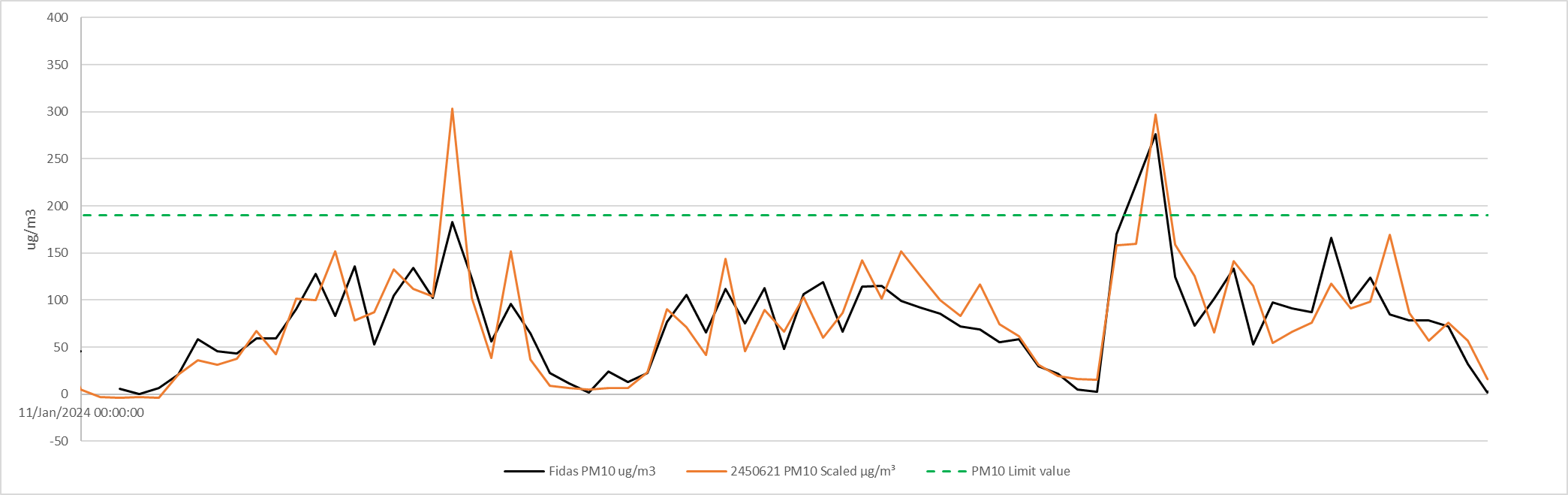
- Measurements will closely match reference equipment (see chart below)
- Dust events will be clearly visible
- Triggers for dust suppression will activate reliably
- Compliance checks become straightforward
- Data can be trusted for audits and investigations
AQMesh provides comparison charts and validation data demonstrating performance consistency across many construction sites. As you can see on this chart, the AQMesh small sensor system (orange) closely tracks the reference station (black).
Conclusion: Don’t Let Incorrect PM10 Measurements Put You at Risk
With regulators increasing scrutiny and IAQM highlighting under-reporting, PM10 monitoring will have increasing scrutiny.
The key takeaway:
If your PM10 monitor does not contain a sensor capable of measuring coarse sized particles, your data cannot be relied on.
AQMesh provides:
- True PM10 measurement
- MCERTS-certified performance
- Proven alignment with reference methods
- Stable operation in challenging outdoor conditions using the optional heated inlet
If you want a system that delivers trustworthy PM10 air quality data, get in touch.
We support IAQM’s commitment to transparency, evidence-based assurance and alignment with PAS 4023:2023 and will continue contributing to industry-wide efforts to raise monitoring standards.